- Shot tracking
- Movement & speed
- Match analysis
How it works
Two cameras.
One picture.
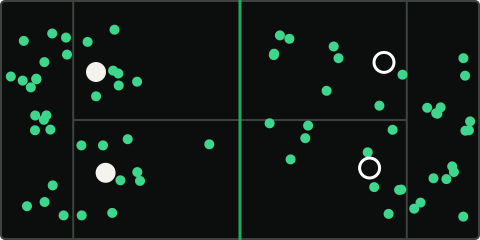
A camera at each end of the court watches the ball, the players and the rackets. Using advanced computer vision, the two views become the shots, the speed, the movement and where the ball lands. The tablet on court shows it live.
- Match mode
Four players, one game. Shots, speed, movement, serves and where the ball lands.
- Training mode
A coach and students. Drills, repetitions and where each ball lands.
01 — At a glance
The match,
at a glance.
Every shot is classified as it happens: serve, from the back, lob, volley, bandeja and smash. Ball speed sits right beside the mix.
Sat 11 Oct · both teams
- Serve112
- From the back300
- Lob88
- Volley250
- Bandeja95
- Smash55
- 900
- Shots
- 68
- km/h average
- 118
- km/h max
Max 118 km/h
8% second serve · 4% double faults
5.1 km/h average movement
02 — Serves
Read
every serve.
First serve, second serve and double faults are shares of the service points. Landings are split across the T, the body and the side wall.
Serve placement
100 service points · avg 86 km/h
Back of the court
Team coordinationLateral 74%Depth 61%
03 — On court
Where the point
is played.
Time in the back, transition and volley zones, whether partners move together, and how many points end in the net or the glass.
Direct errors
On the opponent side

For clubs
Bring a new perspective
to your club.
Give every court a camera eye. Players leave with a clear picture of their game, and your club becomes the place people come to get better.
Request demo- 01One tablet per court
- 02A match report for every player
- 03Insight into how your courts are used